

.png?width=960&height=530&name=Portal%20image%20(7).png "Portal image (7)")
 Back to Blog
By Tim Marshall |
September 2, 2026 |
Five minutes was acceptable. Under a second is now possible.
Until now, organisations running Oracle Standard Edition (Oracle SE) have had a fairly clear set of choices for protecting their databases. If you wanted a straightforward, cost-effective disaster recovery (DR) setup, a physical standby database with a recovery point measured in minutes was a very reasonable option. For many organisations, it still is.
But if your business could not afford to lose those few minutes of data, the options became more complicated. Achieving a much lower recovery point typically meant looking towards Oracle Enterprise Edition and Data Guard, or additional complex replication technologies and the cost and fragility that came with them. It was a compromise many Oracle SE users simply accepted.
That compromise has now changed.
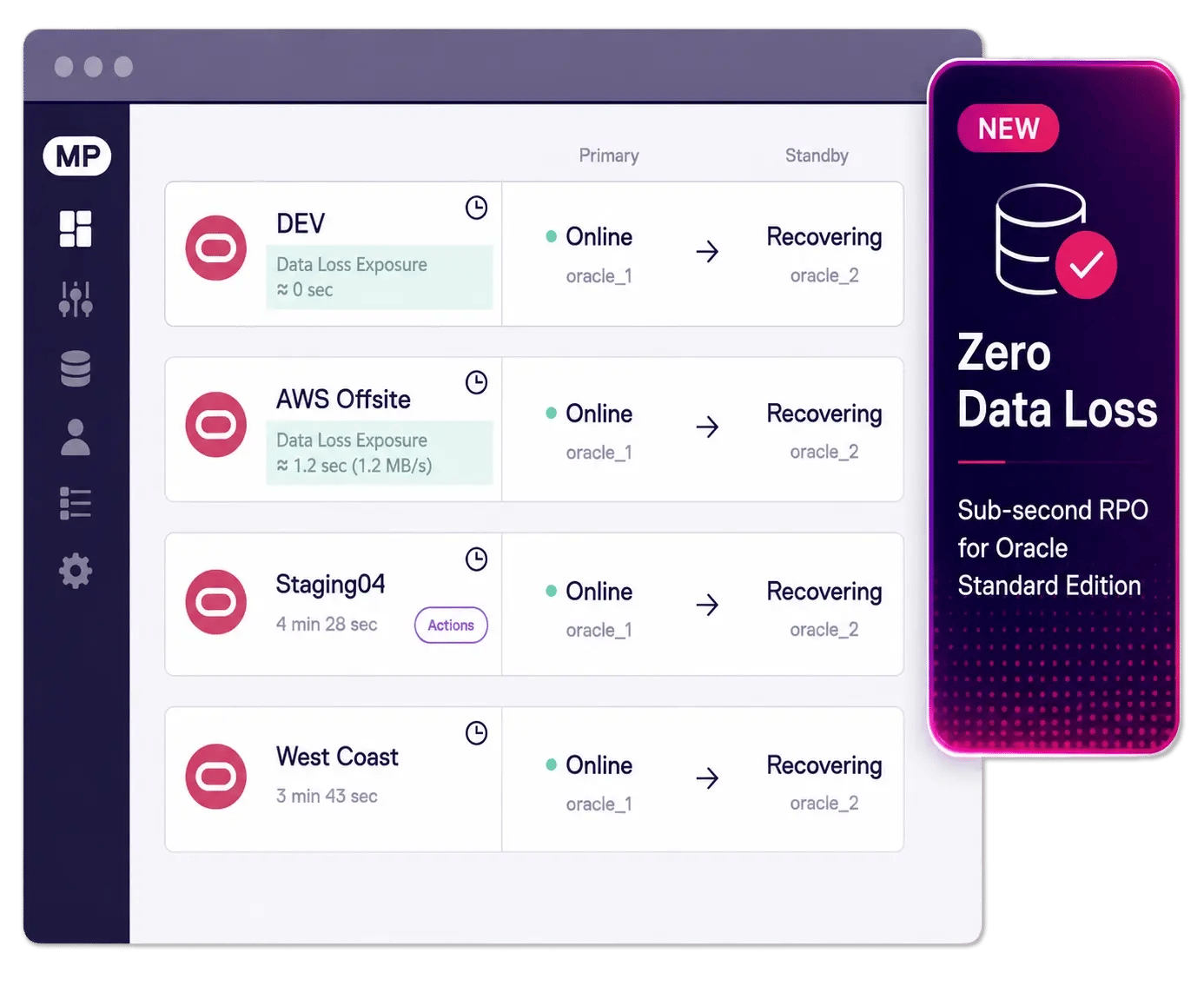
Today, we're introducing Zero Data Loss (ZDL) for StandbyMP on Oracle SE, a new option that dramatically reduces the amount of recent data at risk in an Oracle SE disaster recovery environment. In suitable environments, ZDL takes potential data loss from minutes to less than a second.
And importantly, it does this while allowing you to stay on Oracle SE, without requiring new infrastructure or adding unnecessary operational complexity. For organisations where every transaction matters, that's a significant change.
What could five minutes actually mean?
Recovery Point Objective, or RPO, can sometimes feel like just another technical metric. Five minutes. One minute. One second. But what matters is what happens inside that time.
For a busy database, five minutes could contain payments being processed, bookings being made, inventory moving, patient information being updated or thousands of other transactions. The presentation captures this particularly well: a second can seem insignificant until you consider what can happen inside one.
If an outage happens at the wrong moment, those missing transactions can create work long after the database itself has been recovered. Someone may need to determine what was lost. Records may need to be checked. Transactions may need to be verified or recreated.
So the question isn't only: how quickly can we get the database running again?
It's also: how much lost data will be there when we do?
So, how does Zero Data Loss work?
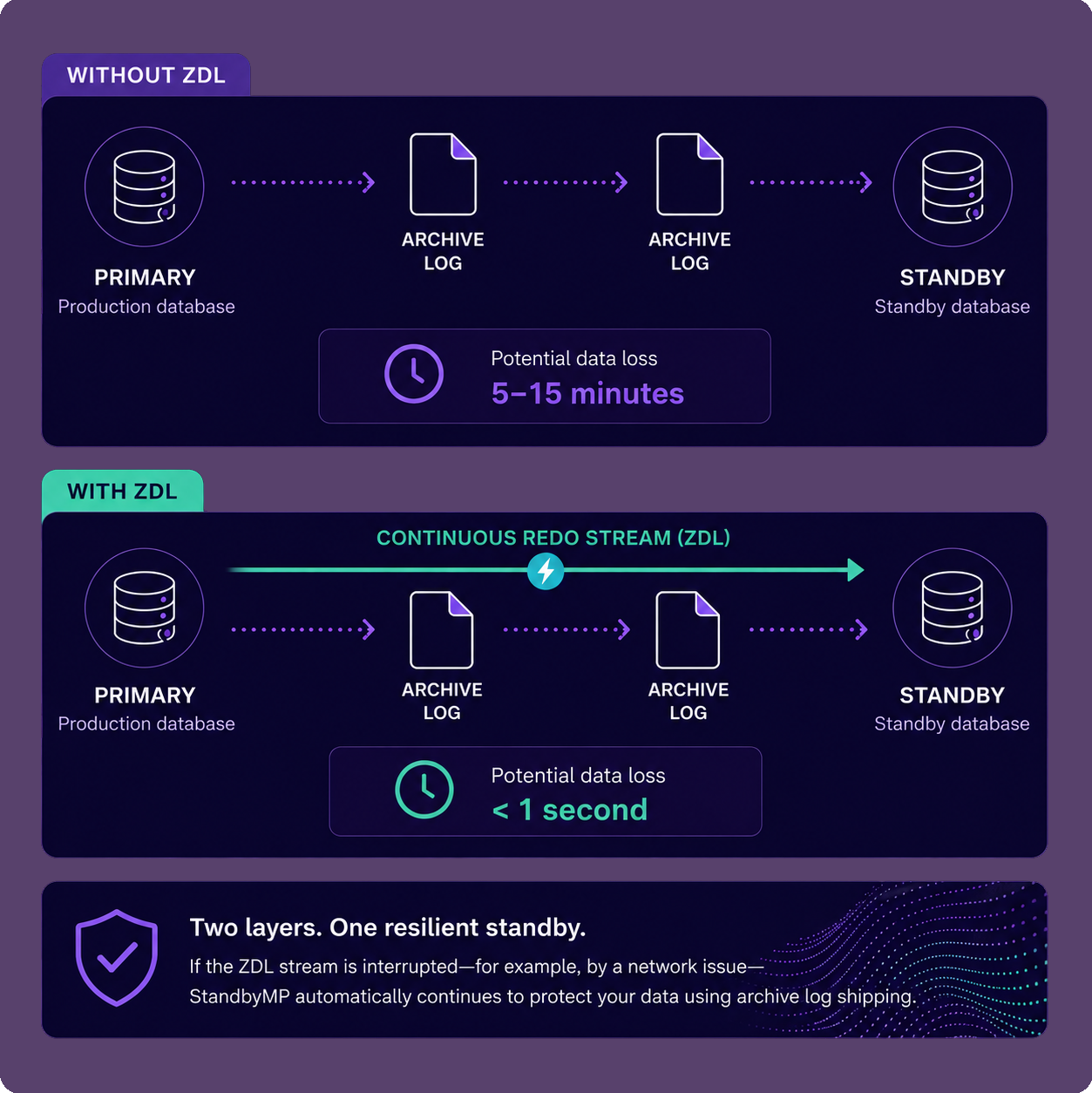
The idea behind ZDL is actually quite simple. Our DR solution traditionally protects an Oracle SE database by transferring and applying archived redo logs to a standby database. Generally, these archive logs are shipped every 5-15 minutes, which means a failure at the wrong moment could cost you that entire window. ZDL closes the gap. It continuously streams Oracle's redo log data to your standby in real time, while your existing archive log shipping runs alongside it completely untouched.
That means you don't have to wait for the next archive log before the latest database changes start making their way to your standby environment. The two processes work alongside each other, helping keep the standby much closer to the primary and reducing potential exposure to under a second in suitable environments. This was protection previously exclusive to Oracle Data Guard on Enterprise Edition. Now there is no EE licence or new infrastructure requirement. That's the simple explanation.
The important part is what you don't have to change
We wanted to avoid solving the data loss problem by simply adding a different kind of complexity. ZDL is an optional capability within Dbvisit’s StandbyMP product. It doesn't require organisations to move to Enterprise Edition, deploy new infrastructure, or create new dependencies, just to achieve a significantly lower recovery point. It is designed to be enabled within the existing StandbyMP environment with minimal overhead.
Existing Dbvisit customers also don't need to rethink the DR strategy they've already put in place. The protection you have today hasn't suddenly become wrong because something better is now possible. Technology has simply moved forward. And that brings us to the question we think Oracle SE users should now be asking.
If you no longer have to accept five minutes, why would you?
For a long time, a recovery point measured in minutes was an accepted compromise for Oracle SE. Not because losing data was desirable, but because achieving a significantly lower RPO meant taking on additional cost or complexity. ZDL changes that. You can now reduce potential data loss from minutes to less than a second in suitable environments, while staying on Oracle SE and without introducing new infrastructure or unnecessary operational complexity.
And when the upgrade itself is straightforward, the question becomes pretty simple: if you can protect more of your data, why wouldn't you? That's ultimately what Zero Data Loss is about: closing that final gap and giving customers a level of data protection that simply wasn't possible before. And when it comes to protecting your business data, it's difficult to argue with having more of it protected.
Ready to take a closer look?
Zero Data Loss changes what’s possible for Oracle SE. Whether you want a quick overview, want to see it in action, or want to understand the technology behind it, here’s where to go next:
-
Explore the key capabilities and benefits of StandbyMP Zero Data Loss on our feature page.
-
Express your interest or request an upgrade by booking a discussion call with our team.
-
Read the V12.4 Release Notes and technical documentation.
-
Download the Trial with a license key for your environment, or try it in our Test Drive cloud environment.