
ZERO DATA LOSS DISASTER RECOVERY FOR ORACLE SE
Sub-second data loss protection for Oracle SE
The Zero Data Loss (ZDL) option sets a new benchmark, redefining best-practice disaster recovery on Oracle SE.
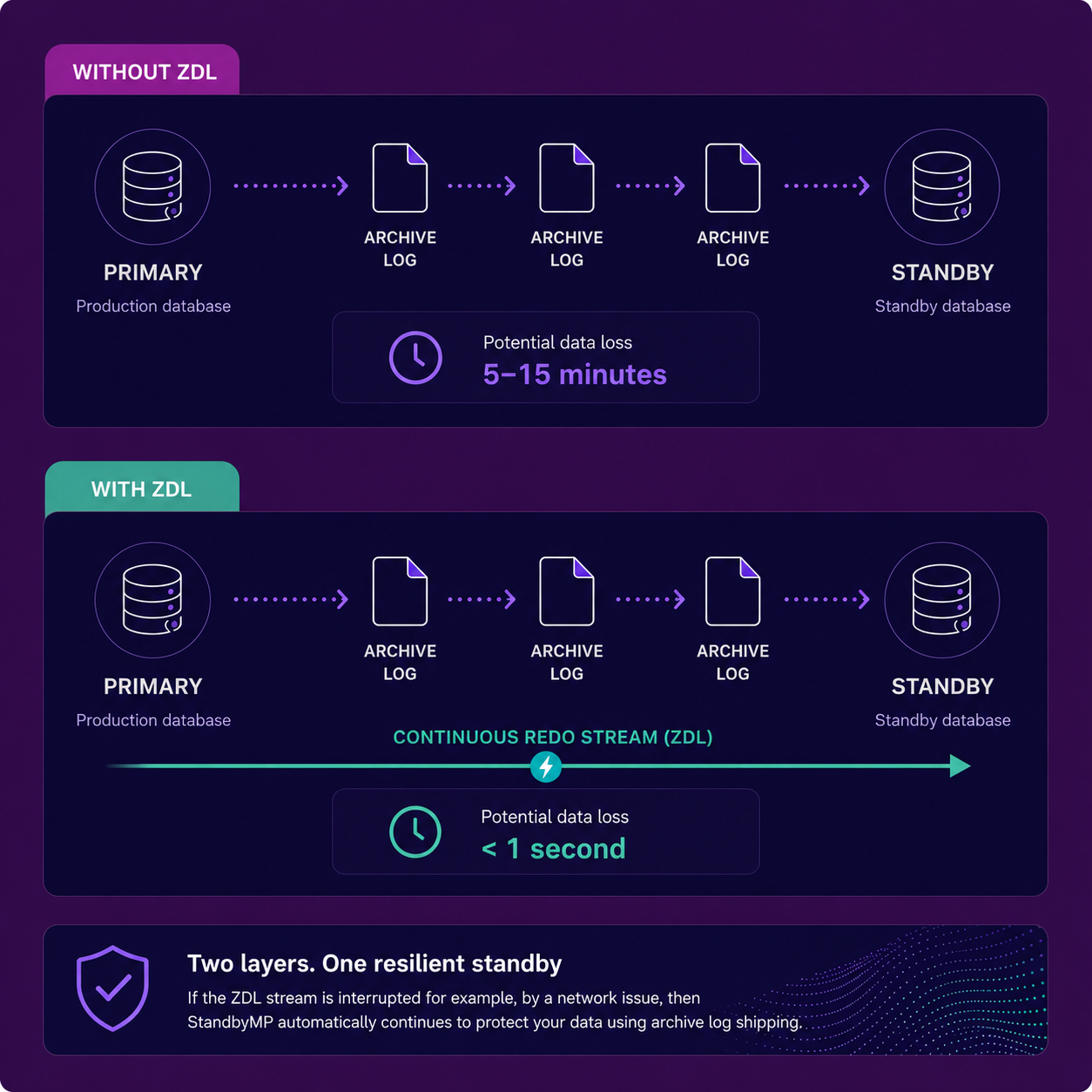
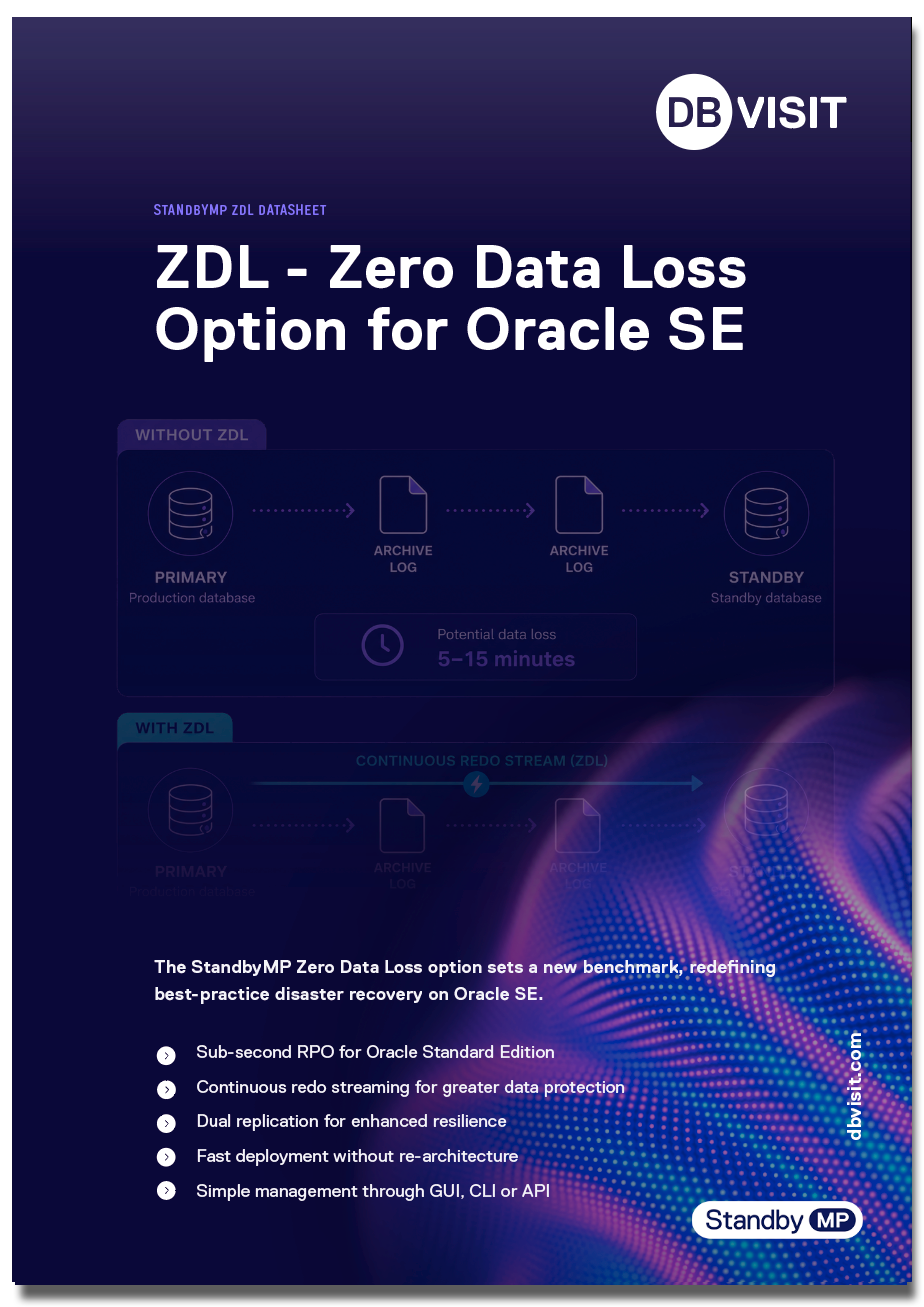
Traditional methods ship archive logs every 5–15 minutes, which means a failure at the wrong moment could cost you that entire window. StandbyMP ZDL closes the gap.
The result is a standby that remains much closer to the primary, reducing data loss exposure from minutes to sub-second levels, and delivering Enterprise-grade protection at Standard Edition cost.

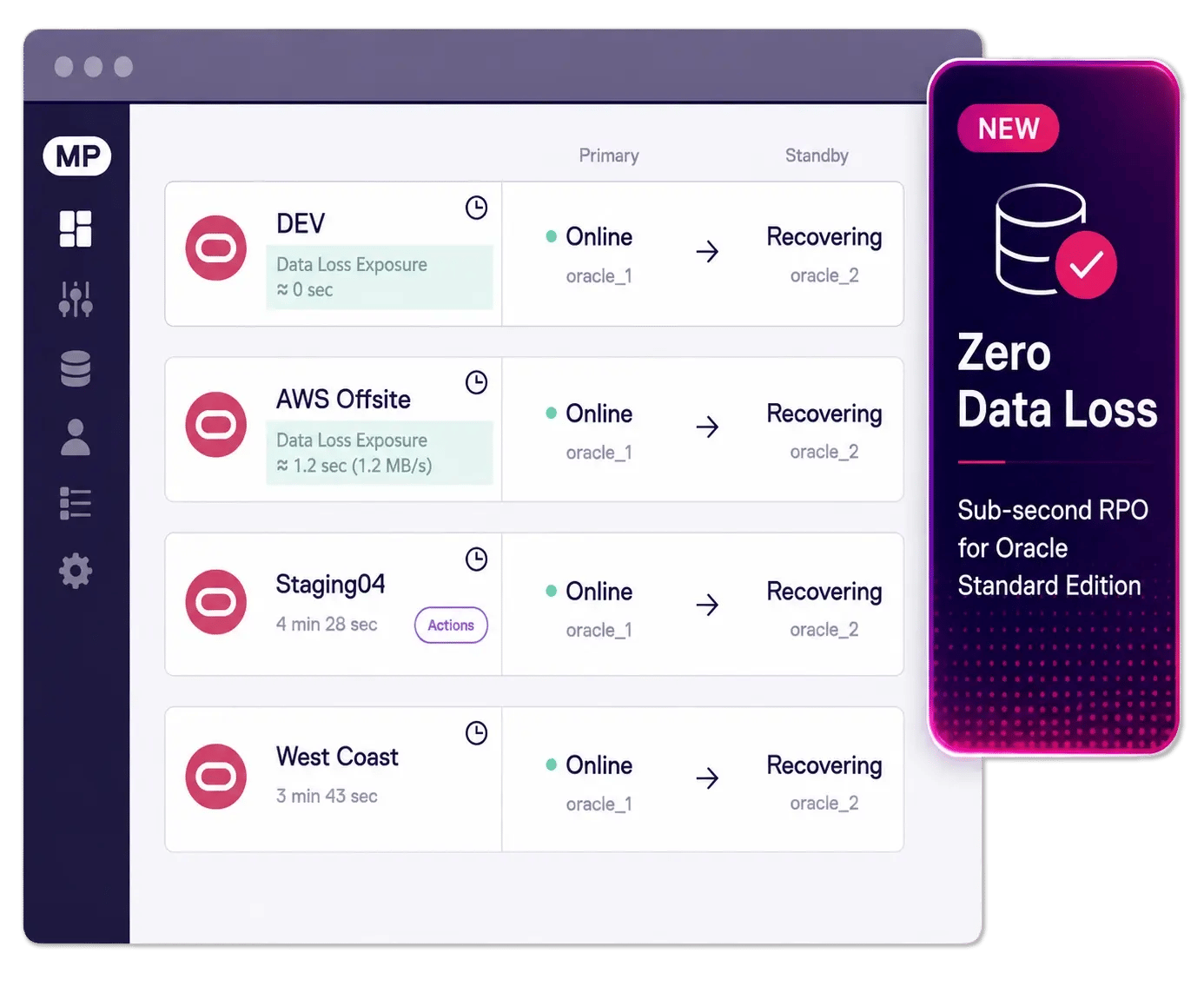






The protection you need, without the Enterprise Edition upgrade.
Achieving an extremely low Recovery Point Objective (RPO) on Oracle has traditionally meant accepting a compromise: higher licensing costs, greater complexity or infrastructure changes.
ZDL changes the game.
The ZDL option brings sub-second protection to Oracle Standard Edition (Oracle SE), allowing you to retain the licensing economics while dramatically reducing your potential data loss.
Get enterprise-grade resilience with Standard Edition economics.
Watch the video and see how.

INTRODUCING ZERO DATA LOSS
Sub-second RPO is now available!
StandbyMP ZDL adds continuous redo streaming alongside proven archive log replication, giving you sub-second RPO and greater Oracle SE protection without the cost and complexity of moving to Enterprise Edition.
- Sub-second RPO dramatically reduces potential data loss.
- Continuous redo streaming replicates changes as they are generated.
- Dual replication combines ZDL streaming with proven archive log shipping.
- Simple deployment adds ZDL without complex re-architecture or infrastructure changes.
- Easy management through the StandbyMP Control Centre or CLI.
HOW IT WORKS
The ZDL Architecture
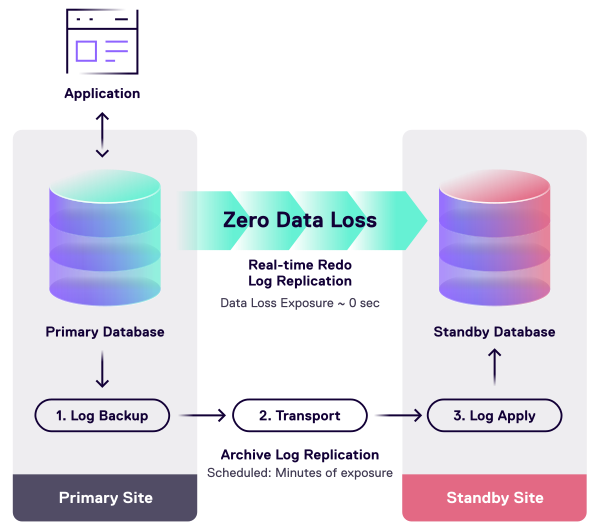
ZDL is an additional real-time replication layer that augments, rather than replaces, StandbyMP's existing Archive Log Shipping technology.
ZDL monitors the primary database’s online redo logs and streams redo to the standby as it is generated, rather than waiting for the next archive log interval. The replicated redo can then be incorporated during standby activation to close the final log gap. This reduces the potential data loss (RPO) from minutes to sub-second.
The two complementary replication paths work together:
- Continuous redo streaming: Streams changes from the online redo logs as they are generated.
- Archive log shipping: Continues transferring and applying completed archive logs.
- ZDL extends, rather than replaces, StandbyMP’s proven replication architecture.

View the ZDL Data Sheet
Discover StandbyMP Zero Data Loss
- Sub-second RPO for Oracle Standard Edition
- Continuous redo streaming
- Dual replication with archive log shipping
- Simple deployment with minimal technical overhead
- Easy management through the Control Center or CLI
- No need for Oracle Enterprise Edition or Data Guard
- Supports existing and new StandbyMP environments, on-premises or in the cloud
/Light/Automated%20Fallover.svg)
Automated Failover
The failover assistant enables one-click failover, triggered manually or automatically.
/Light/Continuous%20Protection.svg)
Great RPO & RTO
Recover from disaster in minutes. Achieve
5-minute RPO with archive log transfer, or
<1-second RPO with the optional ZDL.
/Light/Continual%20Integrity%20Verification.svg)
Graceful Switchovers
Planned switchovers enable easy migrations and testing.
/Light/Cloud%20Ready.svg)
Cloud Ready
Easy to configure on-premise, in hybrid or cloud environments. Supported in Azure, AWS and Oracle Cloud.
/Light/Smart%20Notifications.svg)
Smart Notifications
Real time monitoring with heartbeat notifications, status alerts, and log gap reports.
/Light/One%20Click%20Re-Sync.svg)
One-click Resynchronization
Automated resynchronization removes the risk of being unprotected as a manual rebuild is performed.
Who is Zero Data Loss for?
ZDL is no longer just for your most critical databases.
Historically, achieving near-zero data loss meant higher cost, complexity and technical overhead, making it difficult to justify for anything but the highest-value workloads.
ZDL resets that equation. It brings sub-second RPO to Oracle SE in a solution that's simple to deploy, easy to manage and affordable.
So instead of asking “Which databases justify ZDL?”, the question becomes “Why wouldn’t we protect our databases with sub-second RPO?”
Almost any business where losing recent transactions creates cost, disruption or reconciliation work can benefit. Here are three industry examples where ZDL can make an immediate difference.

Healthcare
Protect the transactions that matter
A healthcare provider runs clinical applications on Oracle SE. Losing even a few minutes of transactions could mean recently entered patient information, appointments or clinical updates need to be identified and reconciled.
-
ZDL reduces that exposure to sub-second levels, helping protect critical data without requiring Enterprise Edition.
Financial Services
When every transaction counts
A financial services organisation processes a continuous stream of customer transactions. After an outage, missing transactions can create significant reconciliation work and delay confidence in the recovered database.
-
ZDL keeps the standby within a fraction of a second of the primary, dramatically reducing the potential transaction gap.

Manufacturing
Keep operations moving
A manufacturer relies on Oracle SE for systems supporting orders, inventory and production. Losing several minutes of database activity can create discrepancies that teams need to resolve before operations return to normal.
-
ZDL provides sub-second RPO, reducing potential data loss and the operational impact of recovery.
.png?width=860&name=Oracle%20Webinar%20thumbnail_updated%20(3).png)

.png?width=860&name=Oracle%20Webinar%20thumbnail_updated%20(1).png)
.png?width=860&name=Oracle%20Webinar%20thumbnail_updated%20(2).png)
.png?width=860&name=Oracle%20Webinar%20thumbnail_updated%20(4).png)