


 Back to Blog
Dbvisit is pleased to announce that StandbyMP now supports Oracle Database 26ai Standard Edition on Oracle Cloud Infrastructure (OCI) Database Cloud Service (DBCS), including hybrid configurations with an on-premises primary and an OCI standby. Customers running Oracle SE on OCI can now bring the same automated, cost-effective disaster recovery to 26ai that StandbyMP has long provided for 19c and 23ai.
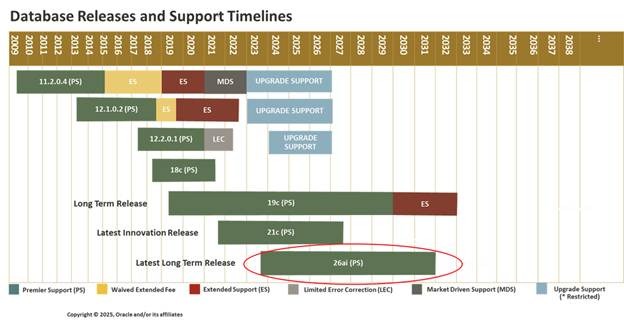
Since 26ai is Oracle's newest long-term release, and the one that will define most upgrade decisions over the next few years, it's worth pausing on where it sits relative to the versions many of you are still running. Below is a quick summary of current support timeframes across Oracle's active long-term releases, before we get into what we tested and how OCI DBCS changes the economics of running Oracle SE.
Where Oracle 26ai fits in the support timeline
Oracle Database 19c – Premier Support runs through December 31, 2029, with Extended Support now confirmed through December 31, 2032. This makes 19c one of the longest-supported releases in Oracle's history, giving customers plenty of runway to plan an upgrade rather than rush one.
Oracle AI Database 26ai (the long-term release that replaces 23ai) – runs through December 31, 2031, with the Extended Support end date still to be announced. Moving from 23ai to 26ai is designed to be a straightforward update to Oracle's latest long-term release, with Oracle not requiring database re-certification as part of the upgrade itself. Individual applications or vendors may have their own certification requirements. Moving from 23ai to 26ai is a straightforward update to the latest release, with no re-certification required. Moving from 19c is also supported directly, via Oracle's AutoUpgrade tool.
For a closer look at how these two timelines came about, and why Oracle extended 19c support as far as it did, see our earlier post: Oracle Support Extended for 19c and 23ai.
On the release side, Oracle AI Database 26ai Enterprise Edition for Linux x86-64 became generally available for on-premises deployments on 27 January 2026. At the same time, Oracle AI Database 26ai was already available on OCI Base Database Service for both Enterprise Edition and Standard Edition. Because customers could begin deploying Oracle 26ai Standard Edition on OCI immediately, we prioritised validating StandbyMP against that platform first.
Why OCI DBCS is worth a look for Oracle SE
OCI's Database Cloud Service platform supports both Enterprise and Standard Edition on 26ai, and it brings a few advantages that make it a genuinely attractive option for teams running Oracle SE, not just a stopgap while they wait for an on-premises release:
-
Flexible licensing: choose license-included or bring-your-own-license (BYOL), with pricing that's competitive against comparable on-premises and other-cloud options.
-
TDE included at no extra cost: Transparent Data Encryption is included in both Enterprise and Standard Edition on DBCS, without the Advanced Security Option licensing that TDE normally requires on Enterprise Edition elsewhere (tablespace-level encryption only).
-
Pay for what you use: you're billed for actual usage, not for downtime or maintenance windows, aside from storage.
[Image retrieved from Oracle]
Why we tested it, and what we found
We started getting enquiries from customers asking a simple question: does Dbvisit support Oracle 26ai Standard Edition on OCI DBCS? Rather than guess, we validated it directly.
The result: installation and configuration worked cleanly, which isn't a huge surprise since we already support earlier Oracle versions on OCI DBCS, including hybrid configurations. Our OCI DBCS user guide walks through the full process:
Once StandbyMP is configured, the next step is creating the standby database. The one step that's easy to miss, but important to get right, is copying the TDE wallet keys from primary to standby before you run the standby database creation. Our wallet copy procedure covers exactly how.
OCI hybrid: running an on-premises primary with an OCI standby
A lot of the customers asking about 26ai support aren't planning to move everything to OCI at once – they want to keep a primary on-premises and use OCI DBCS as the DR site. That's a well-trodden path for us, and we've written a dedicated series covering the details that trip people up, particularly around TDE, since OCI encrypts by default and on-premises Standard Edition often doesn't:
- Setting Up Oracle Hybrid Disaster Recovery with TDE
- Oracle TDE Wallet Setup: What DBAs Get Wrong and How to Get It Right
- Oracle TDE Licensing: What You Need to Know
With 26ai now validated on OCI DBCS, the same hybrid architecture and TDE guidance in those posts applies to 26ai deployments too – we'll be updating them shortly to call that out explicitly and link back here.
What we tested
We ran StandbyMP through the full range of functions we'd expect any production DR setup to rely on:
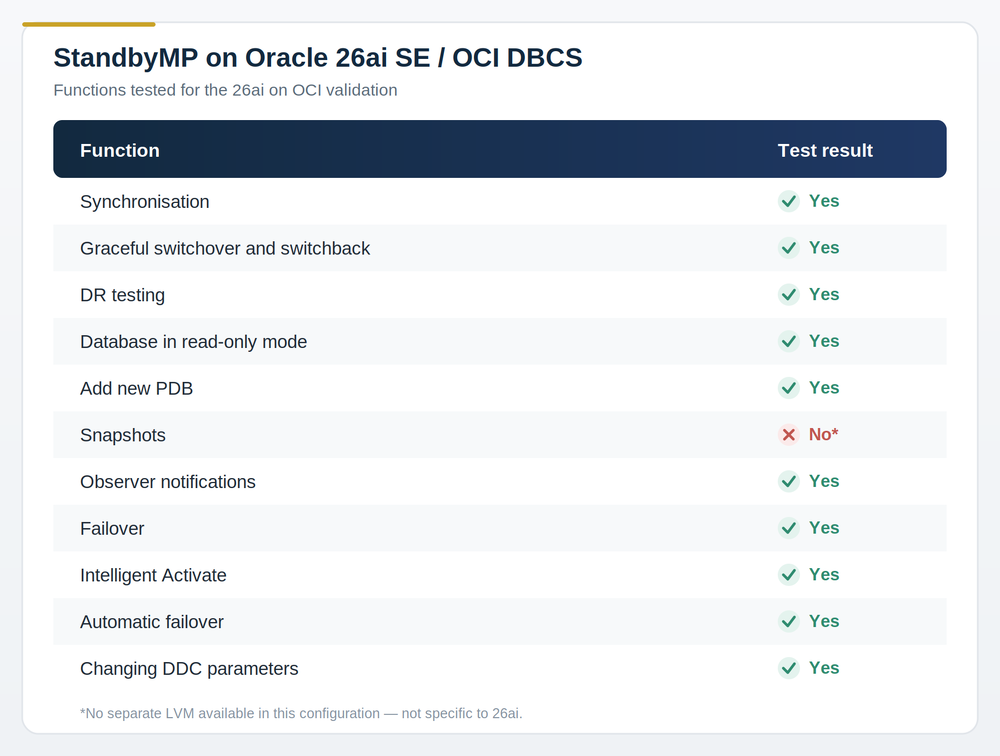
Everything performed as expected on Oracle 26ai Standard Edition on OCI DBCS. The one exception is snapshots, which aren't available in this configuration simply because there's no separate LVM to snapshot, not because of anything specific to 26ai.
What's next
If you're running Oracle SE on OCI, or thinking about a hybrid setup with an on-premises primary and an OCI standby, StandbyMP is ready for 26ai today. We'll be doing the same validation for on-premises Standard Edition as soon as Oracle releases it. In the meantime, if you have questions about your specific environment, get in touch, and we'll help you plan the move.