

 Back to Blog
For years, Oracle Enterprise Edition (EE) has been treated as the default choice for any serious production Oracle environment.
If the database is important, you buy EE.
If high availability matters, you add RAC.
If disaster recovery matters, you add Data Guard.
Over time, Enterprise Edition became less of a technical decision and more of a standard architecture pattern. Why is this? And is it correct?
How EE became the default
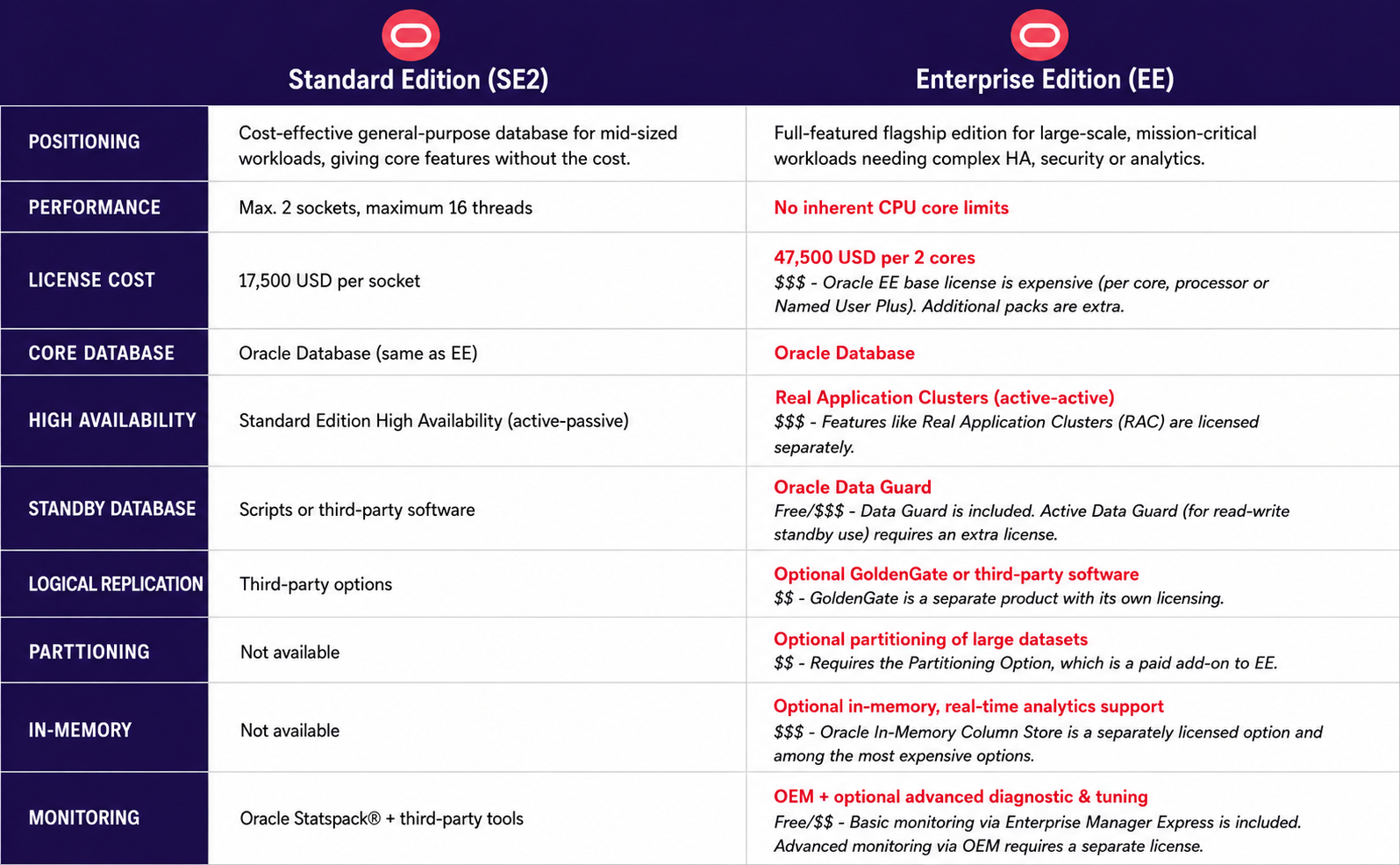
Enterprise Edition is unquestionably powerful. For large-scale enterprise workloads, it provides advanced capabilities (many of which require additional licensing) that Standard Edition does not, including:
- RAC clustering
- Partitioning
- Advanced Compression
- Active Data Guard
- Transparent Data Encryption (TDE)
- In-Memory
- Large-scale CPU scalability
- Advanced diagnostics and tuning capabilities
For some environments, these are operational requirements, not optional features. But many Oracle environments were licensed for EE years ago under very different assumptions:
- Projected growth that never materialised
- “Future-proofing” decisions
- Enterprise architecture standards
- DR requirements
- Application vendor recommendations
- Fear of hitting limitations later
Once Enterprise Edition is implemented, few organisations revisit whether those paid options are still genuinely required.
The feature usage reality
One of the more uncomfortable truths in Oracle licensing is how little of Enterprise Edition is actively used in many environments.
It is common to see organisations licensed for:
- Partitioning
- Diagnostics Pack
- Tuning Pack
- Active Data Guard
- Advanced Security
…while only using a fraction of those capabilities operationally.
In some cases, features were enabled unintentionally through OEM usage, inherited scripts, or legacy configurations. In others, the features were purchased years earlier as insurance against future requirements that never arrived.
That does not mean EE is unjustified. But it does mean many organisations are paying enterprise-level licensing costs for workloads that may not actually require enterprise-level database functionality.
Where Standard Edition fits surprisingly well
Oracle Standard Edition is significantly more capable than many teams realise. For a large percentage of production workloads, SE can comfortably support:
- ERP systems
- departmental applications
- internal business platforms
- standard OLTP workloads
- reporting environments
- line-of-business systems
- moderate concurrency environments
Particularly in environments under a few terabytes with predictable transactional workloads, Standard Edition may provide everything the application genuinely needs. Many businesses are not struggling with database scalability. They are struggling with:
- operational complexity
- licensing cost
- maintainability
- infrastructure overhead
Those are different problems entirely.
Where Enterprise Edition absolutely makes sense
There are still many scenarios where Enterprise Edition is clearly the correct architectural choice.
Examples include:
- very large databases requiring partitioning for manageability
- workloads with extremely high concurrency
- systems requiring RAC-level availability
- advanced enterprise security requirements
- large-scale analytics platforms
- environments needing online operations with minimal downtime
- organisations standardised on advanced Oracle ecosystem tooling
Similarly, some recovery objectives genuinely justify the use of technologies such as Active Data Guard. The important point is not that Enterprise Edition is unnecessary. The important point is that EE should be selected because the workload genuinely requires those capabilities, not because it has historically been treated as the default option.
Disaster Recovery aren't a deciding factor
Historically, disaster recovery was one of the biggest reasons organisations adopted Enterprise Edition. For years, many teams felt pushed toward EE simply because Data Guard was tied to Enterprise licensing.
That created a common situation:
- the workload itself did not necessarily require EE
- but DR requirements effectively forced the licensing decision
That dynamic has changed significantly. Modern third-party physical replication platforms such as Dbvisit StandbyMP now allow organisations to build mature standby environments on Oracle Standard Edition.
For many businesses, that changes the conversation about architecture entirely.
The question is no longer:
“Can Standard Edition support disaster recovery?”
The question becomes:
“Does this workload genuinely require Enterprise Edition capabilities beyond DR?”
A more practical licensing conversation
Consider a regional business running:
- a 1–2 TB ERP database
- several hundred concurrent users
- predictable transactional workloads
- standard reporting requirements
If the environment is not using:
- RAC
- partitioning
- advanced analytics
- in-memory processing
…then it becomes reasonable to ask what operational problem Enterprise Edition is actually solving. That is the conversation more organisations are now having openly. Not because EE lacks value. But because database architecture decisions are increasingly being evaluated against operational reality rather than inherited assumptions.
The goal is alignment, not minimisation
This is not an argument against Enterprise Edition. There are absolutely environments where EE is essential and fully justified. But there are also many Oracle environments where Standard Edition aligns more closely with the organisation’s actual operational requirements. The goal should not be minimising licensing costs at all costs.
The goal should be aligning:
- architecture
- operational complexity
- scalability requirements
- recovery objectives
- and licensing investment
with the real needs of the business.
Because the better question is not:
“Do you need Enterprise Edition?”
It is:
“What operational problem are you actually trying to solve?”
Next steps
Continue the series: Read our next blog to learn how to evaluate your Oracle deployments and identify opportunities to optimise performance, licensing, and costs ➡️ https://dbvisit.com/blog/do-you-actually-need-oracle-enterprise-edition-dbas-guide-to-evaluating-oracle-deployments
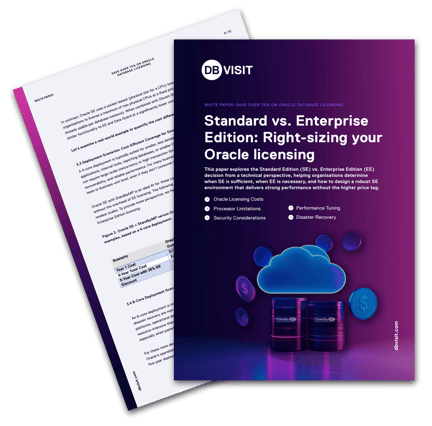
Go deeper: Download our white paper, Standard vs. Enterprise Edition: Right-sizing Your Oracle Licensing ➡️ https://dbvisit.com/hubfs/Oracle%20White%20Papers/Right-sizing%20your%20Oracle%20licensing_WP.pdf
The paper provides a technical comparison of Oracle Standard Edition (SE) and Enterprise Edition (EE), helping organisations determine when SE is the right fit, when EE is genuinely required, and how to design a high-performing, resilient SE environment that delivers enterprise-grade outcomes without the added licensing costs.