


 Back to Blog
Evaluating Oracle Standard Edition, Enterprise Edition, and Disaster Recovery Options for Modern DBA Environments
For many, Oracle Enterprise Edition (EE) has become the default choice for production Oracle deployments. If the workload is considered important, EE is assumed to be the “safe” option.
Too often, the decision to use EE is made early and rarely revisited. In fact, many DBAs are not even aware that Standard Edition (SE) exists, let alone the nuanced differences between SE and EE. However, many DBA teams are now reassessing that assumption.
Rising Oracle licensing costs, audit exposure, and increasing focus on operational simplicity are driving renewed interest in Oracle SE, particularly when combined with third-party tools that can close the gap between SE and EE’s functionality.
This article explores:
> Oracle EE vs SE
> Oracle SE disaster recovery
> Oracle SE high availability
> Oracle SE limitations
> Oracle SE Data Guard alternatives
> Oracle licensing cost reduction
> Multi-region Oracle DR
The goal is not to argue that EE is unnecessary. It is to understand how to evaluate your requirements and weigh these against the significant cost differential that exists between SE and EE.
Why Oracle EE Became the Default
Oracle built its reputation as the enterprise database platform for large organisations, financial institutions, government, and mission-critical systems. Over time, EE became synonymous with “serious” Oracle deployments. EE also provides access to Oracle’s broader ecosystem of advanced capabilities:
> Oracle Data Guard
> Active Data Guard
> RAC
> Partitioning
> Diagnostics Pack
> Tuning Pack
> Advanced Security
> GoldenGate
> In-Memory
For many organisations, the assumption became: “If we may need advanced features later, we should deploy EE now.” The problem is that this often leads to over-licensing.
Most Organisations Do Not Fully Utilise EE Features
One of the clearest observations across many Oracle environments is that EE capabilities are often significantly underutilised. This is particularly common where:
> EE was selected as a default standard
> Future growth was overestimated
> Architecture decisions were driven by perceived risk
> Organisations wanted “maximum flexibility”
In practice, many workloads remain relatively conventional:
> OLTP systems
> Departmental applications
> Line-of-business platforms
> Regional ERP systems
> Standard reporting environments
These workloads often do not require:
> RAC
> partitioning
> in-memory
> Active Data Guard
> advanced tuning packs
Yet organisations often continue paying for them. In many environments, only a small percentage of the advanced features licensed are actively used in production.
Oracle SE vs Oracle EE
There is a common misconception that Oracle SE is a ‘light’ or ‘beginner’ version of EE. This could not be further from the truth. SE utilises the same underlying core database engine and is more than capable of running everything but the most demanding workloads.
What Oracle SE includes:
> The core Oracle database engine
> Oracle SQL and PL/SQL
> RMAN backup and recovery
> Security controls
> Oracle Data Pump
> Oracle networking
> Oracle standby database support through third-party tooling
> Standard Oracle operational tooling
> Advanced performance tuning through third-party tooling
For most applications, this is more than sufficient.
Oracle SE Limitations
DBAs evaluating Oracle SE need to clearly understand its architectural limitations.
Processor and core limits
Oracle Standard Edition 2 (SE2) is limited to:
> Maximum 2 CPU sockets
> Maximum 8 cores and 16 CPU threads per database instance
This is one of the most important Oracle SE limitations. For many workloads, this is entirely acceptable. Modern CPUs provide significant performance capacity, and many transactional systems never approach these limits.
However, EE becomes necessary where:
> Very high concurrency exists
> Large-scale analytics are required
> CPU scaling requirements exceed SE limits
> Consolidation density becomes extreme
Oracle Licensing Cost Differences
The technical differentiation is important to understand because the cost difference between SE and EE is substantial. We are going to work in general terms, as everyone pays different amounts for their licensing based on volumes and negotiated discounts. However, EE is typically several times more expensive than SE, even before optional packs are added.
That gap increases significantly once organisations add:
> Active Data Guard
> Advanced Security
> GoldenGate
> RAC
> Diagnostics and Tuning Packs
This creates multiple layers of EE cost. For example:
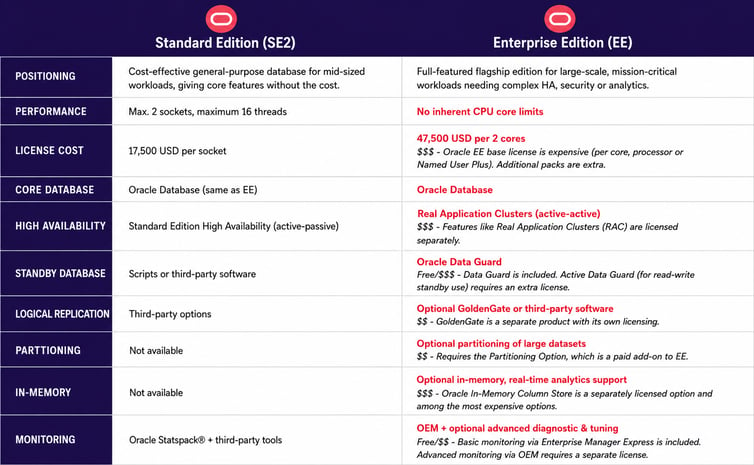
This is why Oracle licensing cost reduction has become such a major topic for DBA teams. To learn more, read our white paper on EE vs SE costs. This paper explores the SE vs. EE decision from a technical perspective, helping organisations determine when SE is sufficient, when EE is necessary, and how to design a robust SE environment that delivers strong performance without the higher price tag
Oracle SE and DR
Historically, one of the biggest reasons organisations selected EE was for DR, specifically, Oracle Data Guard. For many DBAs, the lack of Oracle Data Guard support in SE was viewed as a major blocker. This created a situation where organisations did not necessarily need EE performance features, but still required Oracle DR. Therefore, EE became mandatory.
This is where Oracle SE Data Guard alternatives become important. StandbyMP as an Oracle Data Guard Alternative StandbyMP changes the DR conversation for Oracle SE.
It provides:
> Oracle standby database management
> Physical replication
> Switchover and failover
> Monitoring and alerting
> Multi-region Oracle DR
> DR automation
> Managed DR workflows
> Near-zero data loss capabilities
This allows organisations to build enterprise-grade Oracle SE DR environments without EE licensing.
There is a full StandbyMP vs Data Guard comparison
With the DR limitations removed, Oracle SE plus StandbyMP fits particularly well for:
> Mid-sized production environments
> Regional applications
> Customer-facing transactional systems
> Internal enterprise applications
> Cost-sensitive production workloads
> Multi-region DR environments
> Organisations standardising on Oracle SE
In these scenarios, organisations often achieve:
> Significant Oracle licensing cost reduction
> Enterprise-grade standby capability
> Lower operational complexity
> Simplified DR management
When EE Is Still the Right Choice, and remains essential in some scenarios:
> EE is typically justified where organisations require:
> RAC clustering
> Very high scalability
> Extreme transaction throughput
> Heavy partitioning
> Advanced in-memory analytics
> Active Data Guard read replicas
> Advanced encryption mandates
> Advanced tuning diagnostics
> Large enterprise consolidation
Final Thoughts: Start with Requirements, Not Assumptions
Many Oracle environments are designed around assumptions rather than requirements. EE absolutely has a place. However, many DBA teams are now realising that:
1. They do not need every EE feature
2. They rarely use advanced packs
3. They are paying heavily for theoretical flexibility
4. Simpler architectures are often easier to operate
For organisations evaluating Oracle deployments today, the correct approach is not “EE by default.”
The correct approach is:
> understand workload requirements
> understand scalability needs
> evaluate DR requirements carefully
> assess actual feature usage
> model long-term licensing costs
> determine whether Oracle SE disaster recovery requirements can be met using StandbyMP
In many environments, Oracle SE plus StandbyMP is now capable of delivering:
> enterprise-grade disaster recovery
> Oracle standby database capability
> multi-region resilience
> high availability
> significantly reduced licensing cost
And that makes Oracle SE far more relevant than many organisations realise.
Learn more. Read our white paper Standard vs. Enterprise Edition: Right-sizing your Oracle licensing
This paper explores the SE vs. EE decision from a technical perspective, helping organisations determine when SE is sufficient, when EE is necessary, and how to design a robust SE environment that delivers strong performance without the higher price tag.
FAQ
Do I actually need Oracle Enterprise Edition?
Not necessarily. Many organizations deploy Oracle Enterprise Edition (EE) by default without fully assessing whether they use the advanced features it provides. If your environment does not require capabilities such as RAC, Data Guard, Partitioning, Diagnostics Pack, Tuning Pack, or Advanced Security, Oracle Standard Edition (SE) may be a more cost-effective option.
What is the difference between Oracle Enterprise Edition and Standard Edition?
Oracle Enterprise Edition includes advanced capabilities for high availability, performance tuning, scalability, security, and analytics. Oracle Standard Edition provides the core Oracle Database functionality required by many production workloads but without features such as Oracle Data Guard, RAC, Partitioning, Diagnostics Pack, and Tuning Pack.
How do you determine whether Oracle EE or SE is the best fit for your environment?
The decision should be based on your actual business and technical requirements rather than assumptions. Evaluate factors such as availability requirements, scalability needs, performance objectives, compliance requirements, disaster recovery strategy, and budget. If you do not rely on advanced Enterprise Edition features, Standard Edition may provide the functionality you need at a significantly lower cost.
How much can businesses save by using Oracle Standard Edition instead of Enterprise Edition?
Licensing savings can be substantial. Based on an 8-core deployment, organizations can save approximately USD $438,000 (75%) per database over five years by using Oracle Standard Edition with Dbvisit StandbyMP instead of Oracle Enterprise Edition with Oracle Data Guard. Actual savings will vary depending on licensing requirements and infrastructure size.
How do you achieve disaster recovery with Oracle Standard Edition?
While Oracle Data Guard is only available with Enterprise Edition, organizations can implement disaster recovery on Oracle Standard Edition using solutions such as Dbvisit StandbyMP. StandbyMP provides Data Guard-like functionality by creating and maintaining continuously synchronized standby databases that are ready for failover when required.