

 Back to Blog
Oracle Transparent Data Encryption (TDE) is now a default requirement in many cloud environments, especially Oracle Cloud Infrastructure (OCI). While this improves security, it introduces a critical failure point in hybrid disaster recovery (DR) architectures.
Why does Oracle TDE break hybrid disaster recovery?
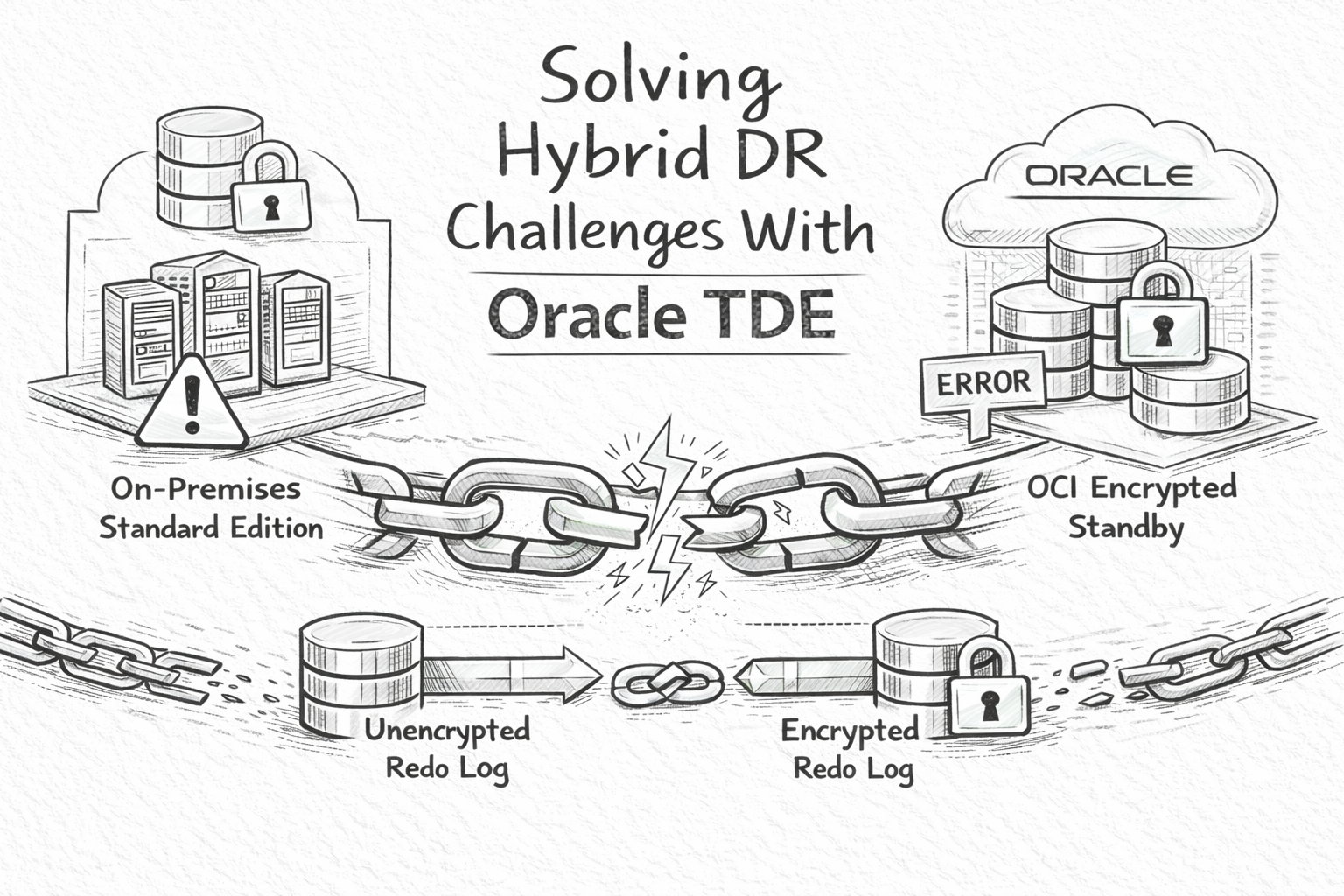
Oracle TDE breaks hybrid disaster recovery because encrypted redo logs generated in a cloud environment cannot be applied to non-encrypted on-premise databases after switchover, causing replication failure.
What I'll cover:
This is Blog #1 in a deep dive into Oracle TDE :
Blog #2 - What is Oracle TDE?
Blog #3 - TDE licensing - when you're allowed to use it
Blog #4 - Best practice TDE wallet creation & management
What is Oracle TDE?
Oracle Transparent Data Encryption (TDE) encrypts data at rest, including:
- Datafiles
- Backups
- Redo logs (when tablespaces are encrypted)
It operates transparently, meaning:
- Applications are unaffected
- Users do not see encryption/decryption processes
This makes TDE essential for security, compliance, and cloud deployment
- TDE is ON in OCI Base Database Service; it's not a design choice.
- This applies to both Oracle SE and Oracle EE.
Why TDE breaks hybrid DR architectures
The Typical Hybrid DR Setup
A common architecture looks like:
- Primary: On-premise Oracle (no TDE)
- Standby: OCI database (TDE enabled by default)
At first, everything works:
- Replication succeeds
- Archive logs ship correctly
- Standby stays in sync
At this point, most teams think they’re done.
Where It Fails
The failure occurs after switchover or failover:
- OCI database becomes the primary
- The unencrypted database becomes the standby
- Redo generated in OCI are now encrypted (TDE)
- That encrypted redo is shipped back to the unencrypted on-prem standby
The problem:
- On-prem systems cannot decrypt redo logs without TDE
- Especially true for Standard Edition (no Advanced Security option)
The Result
-
Replication stops
-
Standby falls behind
-
Hybrid DR is effectively broken
This is not a configuration issue — it is an architectural reality of how encryption and redo interact.
Why Oracle Standard Edition Is Most Impacted
Oracle Enterprise Edition (EE): Can use Data Guard features to manage encryption compatibility, including hybrid scenarios
Oracle Standard Edition (SE):
- OCI Base Database Service, Standard Edition tier, delivers excellent performance, is reasonably priced, and has a license included option.
- But cannot be used for Hybrid DR of on-premise environments due to TDE on the OCI service.

How to design a working hybrid DR architecture
Option 1 — Encrypt Everything
This is Oracle’s recommended approach:
- Enable TDE on both:
- On-prem
- Cloud
Limitations of This Approach
- Requires licensing (Enterprise Edition + Advanced Security)
- Not viable for many SE users
- Adds operational complexity
Option 2 — Use a Replication Layer That Handles Encryption
A more practical approach:
Instead of relying on native database behaviour, use a replication solution that:
- Handles encrypted ↔ non-encrypted environments
- Supports switchover and switchback
- Works with Standard Edition
A Practical Solution: Dbvisit StandbyMP
Dbvisit Standby MultiPlatform (StandbyMP) solves this by:
- Managing replication outside native TDE constraints
- Supporting hybrid environments (on-prem ↔ OCI)
- Enabling:
- Switchover
- Failover
- Reverse replication
This Enables
- True hybrid DR (not just initial sync)
- Compatibility between:
- Non-TDE primary
- TDE-enabled standby
- Support for Oracle Standard Edition
Key Takeaways
- TDE is mandatory in OCI and increasingly standard
- Hybrid DR fails after switchover, not during setup
- Standard Edition users are most impacted
- The solution requires:
- Either full encryption
- Or a replication-aware architecture
READ other articles in this series:
Blog #2 - What is Oracle TDE?
Blog #3 - TDE licensing - when you're allowed to use it
Blog #4 - Best practice TDE wallet creation & management
FAQ
What is Oracle TDE?
Oracle Transparent Data Encryption (TDE) encrypts database data at rest without impacting applications or user access.
Why does TDE break hybrid disaster recovery?
Because encrypted redo logs generated in the cloud cannot be applied to non-encrypted on-prem databases, causing replication failure after switchover.
Does this affect Oracle Standard Edition?
Yes. Standard Edition cannot decrypt encrypted redo logs, making it more affected than Enterprise Edition.
Can Oracle Data Guard solve this?
Only in Enterprise Edition environments with appropriate licensing and configuration.
What is the best way to fix hybrid DR with TDE?
Either:
- Encrypt both environments
- Or use a solution like Dbvisit StandbyMP that handles mixed encryption